The roller coaster ride of total returns on the S&P 500! (Updated to October 2025)

The roller coaster ride of total returns on the S&P 500! (Updated to October 2025)

  • November 17, 2025
    The roller coaster ride of total returns on the S&P 500! 🎱📈 (Updated to October 2025)

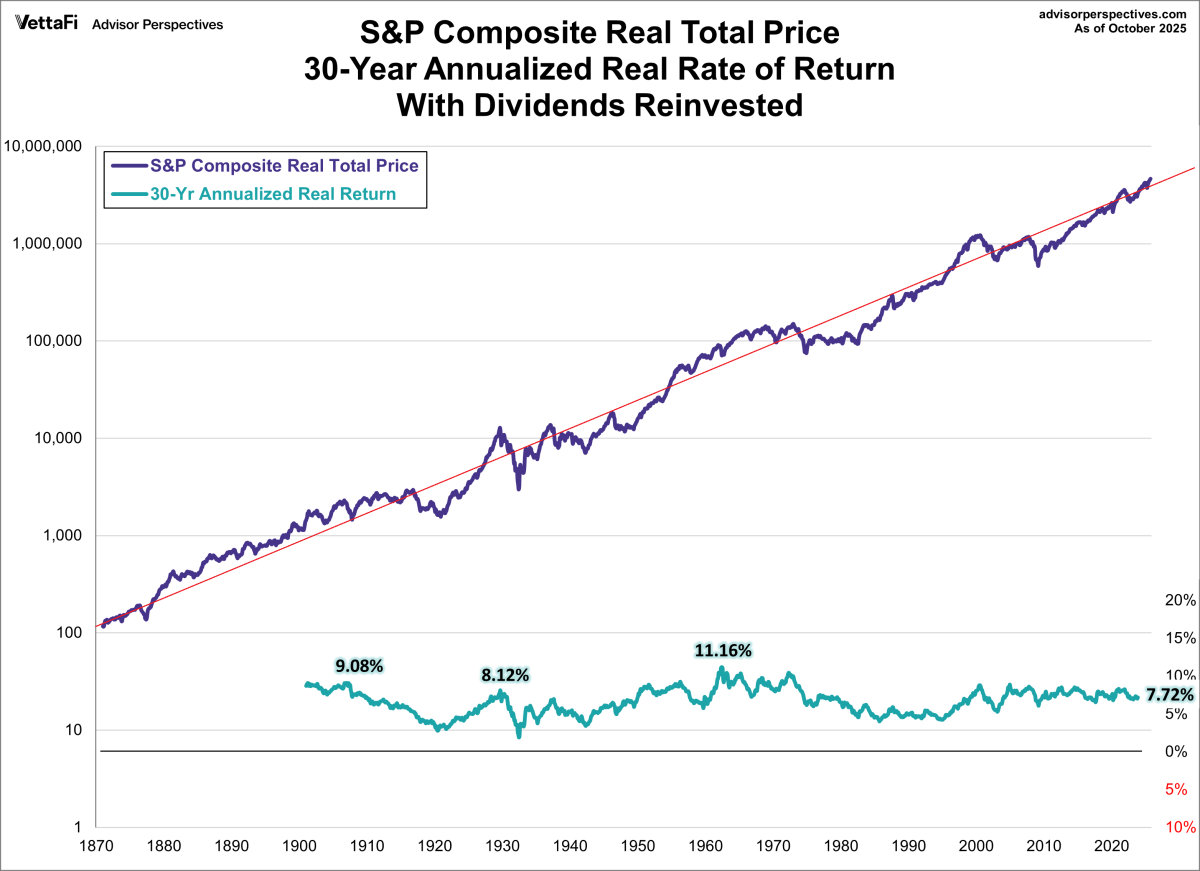
Imagine investing $10,000 in the S&P 500 (with dividends reinvested and adjusted for inflation). How much would you have today depending on when you started?

Last 5 years: +73.84% → $17,384 (actual annualized return: 11.11%)
Last 10 years: +203.65% → $30,365 (11.16% annualized)
Last 15 years: +449.02% → $54,902 (11.41% annualized) ← the best horizon right now!
Last 20 years: +432.45% → $53,245 (8.39% annualized)
Last 30 years: +906.19% → $100,619 (7.72% annualized)
The longer the term, the less crazy the ups and downs are
 but beware: if we had asked this same question in March 2009 (the bottom of the financial crisis), those same 5 years would have left you with only $6,654 in real purchasing power (-8.12% annualized). You would lose a third of the real value!

Continue reading “The roller coaster ride of total returns on the S&P 500! (Updated to October 2025)”

Real total SP500 in the very long term, updated 2023

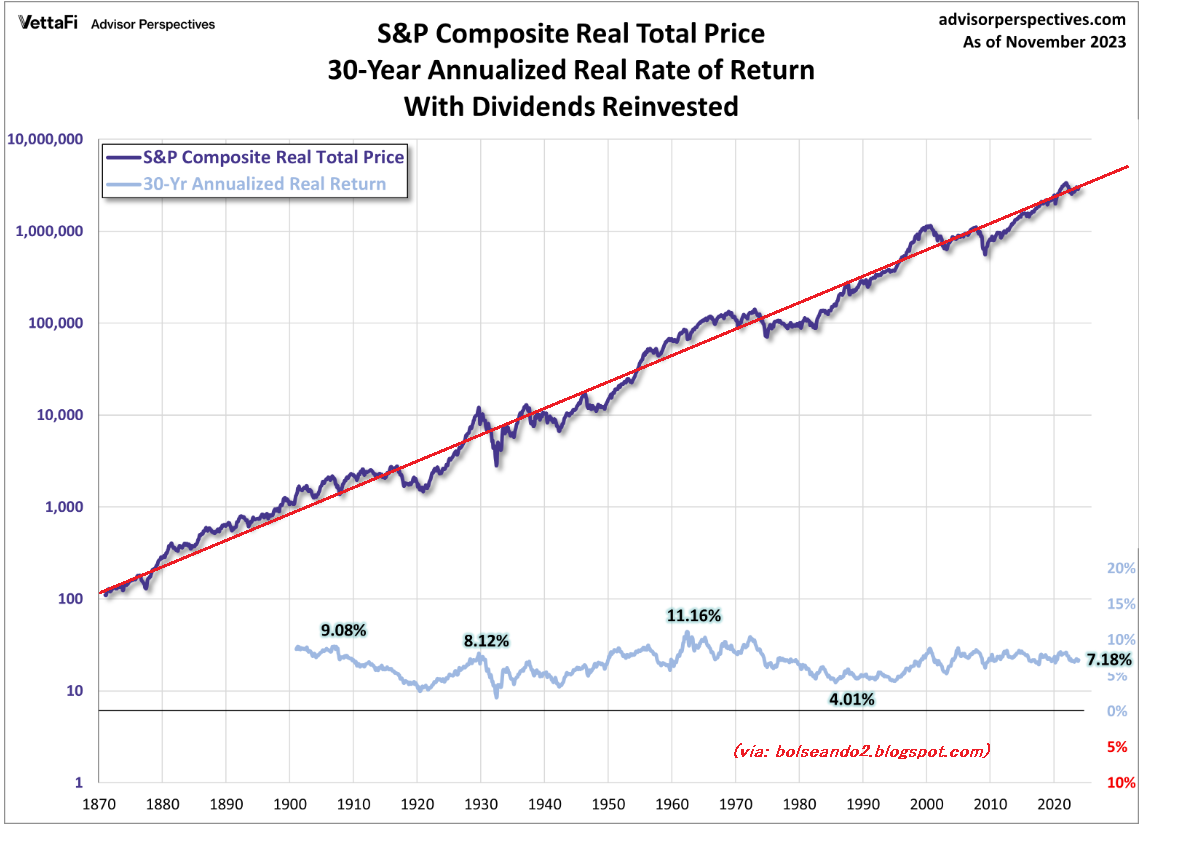
Back in 2010, 2012, 2017, and 2022, I posted some charts here of the “real” S&P 500, i.e., adjusted for inflation, in a semi-logarithmic chart, covering a very long term (since 1870).
I update the chart as usual with a trend line, chart from advisorperspectives.cm

Back in 2010, 2012, and 2017, I posted some charts here of the “real” S&P 500, i.e., adjusted for inflation, in a semi-logarithmic chart, covering a very long term (since 1870).

Continue reading “Real total SP500 in the very long term, updated 2023”

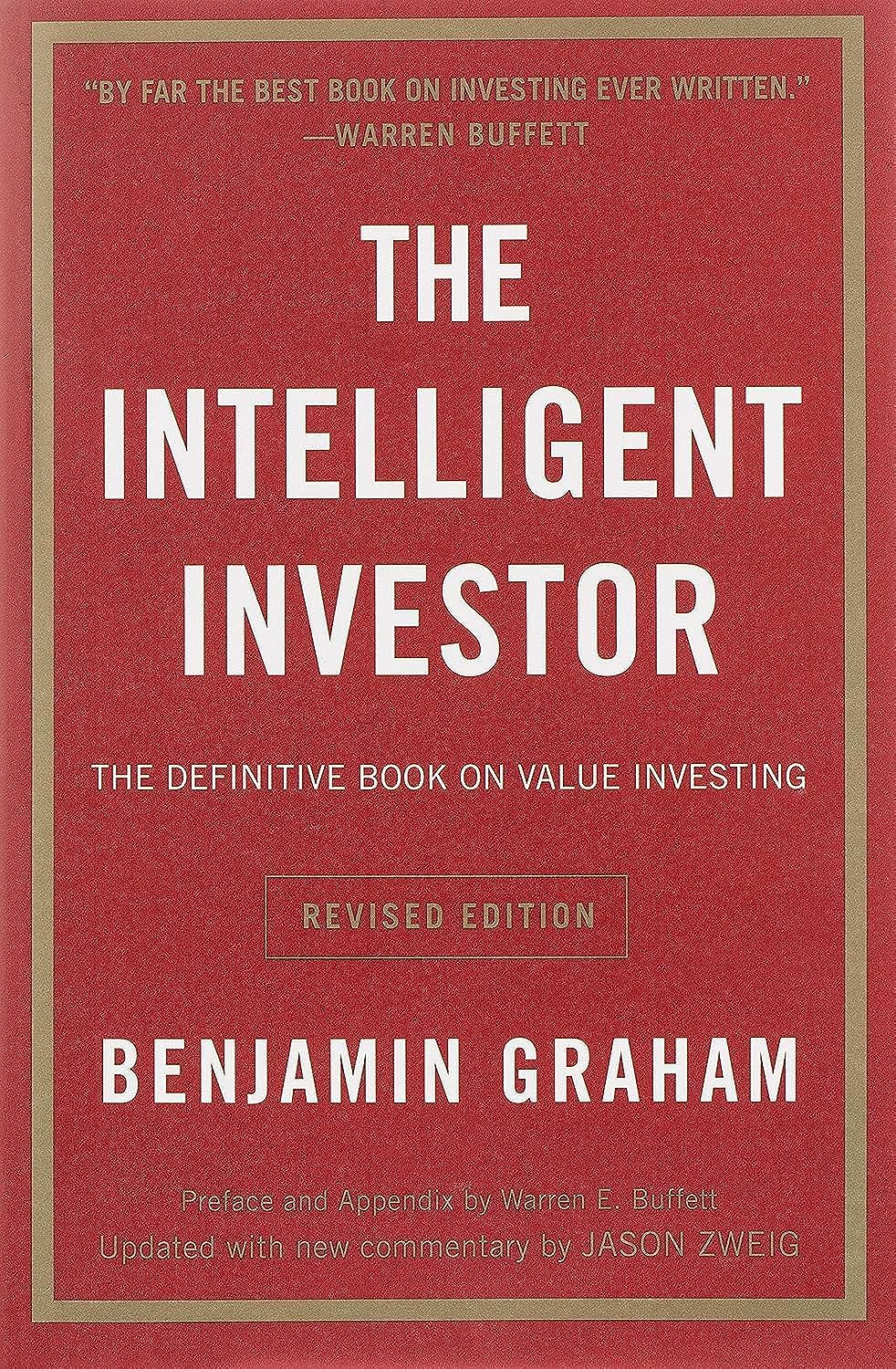
“The Intelligent Investor” From Benjamin Graham

Here is a chapter-by-chapter annotated summary of the book The Intelligent Investor.

The Intelligent Investor is a book written by Benjamin Graham, who is considered the father of value investing. The book is regarded as a classic in the field of investing and has been highly influential in shaping how many people view and practice investment.

In the book, Graham emphasizes the importance of fundamental research in making investment decisions. He argues that investors should look for companies that are undervalued relative to their economic fundamentals, such as net assets, cash flow, and earnings. Graham also discusses the importance of diversification in investing and advises investors not to put all their eggs in one basket.

The book also focuses on the importance of maintaining a long-term approach to investing. Graham argues that investors should be patient and wait for a company’s economic fundamentals to be reflected in its market price over time.

Another important topic in the book is the significance of risk management in investing. Graham advises investors to set loss limits and avoid investing in companies that are in weak financial positions.

In summary, The Intelligent Investor is a fundamental work that offers a practical and well-grounded approach to investing. Benjamin Graham presents concepts and strategies that help investors make informed, long-term decisions and manage risk within their investment portfolios.

You can buy it here.

Expropiation of Repsol, what Argentina seeks

Cristina Kirchner

Argentina —or rather, Cristina Kirchner— has decided on the expropriation of the shares that REPSOL holds in YPF. Or at least almost all of them, since she is taking 51% of YPF out of the 57% that REPSOL owned.

But can we really call this an “expropriation”? Or is it simply a theft?

Why exactly 51% from REPSOL? Why not prorated among all shareholders?

Only one shareholder is being expropriated. This is nothing more than an attack against that specific shareholder —perhaps simply for being a Spanish company? It certainly looks very much like an attack against Spain itself.

The price REPSOL paid for all of YPF was around 13 billion euros. Now, on the stock market, YPF is worth less than 6 billion euros, after the declines caused by rumors of expropriation and the withdrawal of operating concessions —although at the beginning of the year, it was worth twice as much.

So one could say that its market value lies somewhere between 6 and 12 billion euros, more likely around the 12 billion euros it was worth in January 2012.
What valuation will the Argentinians use to determine the “fair price” for the expropriation?

I fear the outcome will lead us to conclude that what Argentina really intends is simply a theft from REPSOL.

[VĂ­a: bolseando, Argentina y REPSOL]

Elliott waves

The Elliott Wave Theory was discovered in the late 1920s by Ralph Nelson Elliott. He found that the stock market does not behave chaotically, but rather in repetitive cycles, reflecting human actions and emotions, largely driven by mass psychology, which he considered the main culprit.

His work was partly based on the Dow Theory, which also uses waves to study the stock market. However, Elliott discovered the fractal nature of the market —the same patterns repeating on larger and smaller scales— and, after years of in-depth study, he identified patterns suitable for making predictions.

From the 1970s onward, the theory gained popularity thanks to the successful predictions of booms and crashes made by Frost and Prechter (“Elliott Wave Principle: Key to Stock Market Profits,” 1978).

Continue reading “Elliott waves”

Simiocracy, from Aleix Salo

After his famous “EspañistĂĄn”, Aleix SalĂł delights us with a new book, and especially with a new video-comic about Spain’s economic crisis.

This time it’s “Simiocracia”, which tells the story of the Spanish economy’s hardships from 2008, when the housing bubble burst, up to the present. Enjoy the video, and don’t forget to revisit the previous one:

Españistån

Comparing 20 years of stocks, oil, pension plans, housing and gold

Let’s take a look at a comparison of 20 investment products, analyzing their performance over the last 20 years, that is, from July 1990 to July 2010. The comparison is very interesting, with oil investment coming out as the winner with an annual gain of 7.09%, and Japanese stock market investment as the loser with an annual loss of 5.72%. Here’s the summary:

MAIN ASSETS
Profitability
Brent
7,09%
Emerging RV
7,02%
RV Spain
6,76%
RV USA
6,61%
RF credits USA
6,21%
RV Alemania
5,99%
Gold
5,94%
RF rental eurozone
5,90%
Mixed RV pension plan
5,72%
Spanish housing
5,32%
RF pension plan credits
5,26%
Mixed RF pension plan
5,11%
RF p USA
5,03%
RF p eurozone
5,03%
Plan pension RF p
4,96%
RV United Kingdom
4,10%
Inflation in Spain
3,37%
RV France
3,13%
RV pension plan
2,17%
RV Japan
-5,72%
Annualized data (performance July 1990 – July 2010)

The evolution of the stock market in the long term, and inflation

(Published on Bolseando2 in Spanish, April 2010)

On dshort.com there are some very interesting long-term charts of the S&P 500.

Let’s look at the following chart, which shows the performance of the S&P 500 from 1870 to 2010, both in nominal terms (the index value you can find on many websites) and in “real” terms, i.e., adjusted for inflation. It also provides charts for the “total” value, taking into account the dividends received over those years, assuming they were reinvested.

Continue reading “The evolution of the stock market in the long term, and inflation”

ESPAÑISTAN, real estate bubble and Spanish crisis

ESPAÑISTAN: The Real Estate Bubble and the Spanish Crisis in Comic Form, by Aleix Saló

Aleix SalĂł is preparing the release of a comic strip set during the Spanish real estate bubble and the subsequent crisis that Spain has been experiencing since 2008.

For its launch, he has created a very interesting video that illustrates the process Spain went through—a process that, in 2011, is still being felt.

Enjoy the video:

.

Y si deseas descargar el vĂ­deo, te recomiendo seguir las siguientes instrucciones para descargar videos desde firefox.

About productivity in Spain and other European countries

On Cotizalia, Kike Vázquez delights us with an article on productivity, which I liked so much that I’m going to share it here:

I don’t know if this happens to everyone, but this whole thing about productivity that people talk so much about has never really been clear to me. They say we work too little, that we’re lazy, that we need to cut our salaries by 25% to start being competitive, or “work a little more and earn a little less,” according to other sources. Wow, Spaniards really are cheeky! Good thing they warn us, because until today I’ve gone out on the street with complete confidence, without fear of being extorted by any of these dangerous characters


So this weekend I decided to investigate this issue, trying to find out how much I should distrust going out of the house and how much I should lower my salary to qualify as an honest citizen (one doesn’t want to be pointed at for being a burden to Spain, after all). For this, I used Eurostat data, to have homogeneous, concrete figures and not rely on other people’s value judgments, which, even with good intentions, are always subjective.

With the multitude of ways to measure this so-called productivity, I wasn’t sure where to start. How about production per worker? That way we can compare who produces more—a Spanish worker, a Portuguese worker, or a German worker, for example. Below are the European Union data and some other countries for comparison, using the terms Eurostat uses (PPS).

labour productivity

If you click on the image and look at it closely, you’ll see that in 2009, the latest available data, the production of a Spanish worker had nothing to envy from a Swede, Dutch, or Italian worker—and even surpasses Germany, the United Kingdom, Denmark, or Japan! It seems that, on average, we’re not as clumsy as we’re sometimes told. The statistics indicate that when a Spaniard works, they produce more than a random worker in the Eurozone. Each worker in our country has a higher output than the average, whether considering the EU-27 or EU-15.

This might seem surprising, but it happens for a very simple reason: Spaniards work a lot of hours. What this graph tells us is that each worker produces more, for example, than a German, but it doesn’t show the time spent or the cost involved. Still, one thing is clear: in Spain, people do work, and they are far from lazy—at least on average.

However, despite the usefulness of this information, the data are somewhat “biased” for those wanting to know real productivity. They talk about output but not efficiency, meaning production rather than productivity, and they don’t account for whether workers are full-time or part-time. To get a clearer picture, let’s take it a step further and chart production per hour worked, a concept that better approximates what we’re actually looking for.

Again, if you click on the chart, you’ll see that, while we cannot compare ourselves to productivity leaders like the United States, Belgium, or the Netherlands, where people work both long hours and efficiently, we are far ahead of others like Greece or Portugal, almost doubling them in this indicator. Comparisons may be uncomfortable, but for all those who place us in the PIGS group and, along with Portugal, recommend that we “improve productivity,” I would suggest taking a closer look at the chart. Interestingly, we are ahead of countries like Italy, the United Kingdom, or Finland, and close to Denmark, Sweden, and even the Eurozone average. I’m starting to feel less guilty about not working for free


It’s clear that we are not far from the Eurozone average (although, according to McKinsey–Fedea, closing this gap could create a million jobs, which is no small thing). On the other hand, we earn much less. According to the same report, hiring a university graduate aged 25–34 in Spain costs €34,000, compared to €66,000 in Germany or €70,000 in the United Kingdom. Comparing this with Eurostat data, we see that British workers are, on average, less productive than us—but earn twice as much! And yet “markets” and bureaucrats recommend that we improve productivity? Incredible!

It’s true that Eurostat figures are adjusted for PPS, meaning purchasing power, so the comparison with salaries is not entirely direct. Even so, it suggests that we may not be as unproductive as we are repeatedly told—“Goebbels-style”, though obviously we should still improve if we want to truly belong to Europe.

Looking at the data again, if a Spanish worker produces more than the Eurozone average and does so in only slightly more time, what’s going on here? Why is everyone pointing fingers at us? What argument is being used? Enter unit labor cost, which is the cost relative to what is produced. Anyone trying to argue that Spain is highly unproductive today will refer to the following chart.

I have tried to include the most representative countries so that we can get an idea. As it’s a little confusing what you see with so many lines, I will try to explain it. If the line goes up, it means the costs to perform the same production are rising in the country, and if it goes down, the reverse is true, therefore it directly impacts competitiveness.

Taking the year 2000 as a base, we can see that at the end of the decade, the countries where salaries have risen the most are Greece, Denmark, the United Kingdom, Italy, Spain, Ireland, Portugal, Belgium, Finland, France, Sweden, and Germany, in that order.

When someone represents this graph, it is a sine qua non condition (or indispensable condition/prerequisite) to overlook that the starting salaries are not equal. That is to say, if a Spaniard earns 100 in the year 2000 and a German earns 150, by the end of the decade the Spaniard will have 130 and the German will have 159. Now then, it must be emphasized several times that we are losing competitiveness, and to make matters worse, eliminate most of the countries from the graph, preferably leaving only Germany, Portugal, Ireland, and Greece. After allowing an audience without further data to compare to reflect for a few minutes, one will say, “It is imperative to increase competitiveness so as not to be rescued,” and everyone will go home remorseful and crestfallen. Mission accomplished.

The reality is that, as we have seen, our productivity is not as distant from that of the Eurozone; since our native salaries are clearly lower than those abroad, it is logical that they tend to equalize. That’s all it is! But also, with that graph, it might give the impression that the average Spaniard has been profiting like never before, which is far from the truth, if we make the same graph eliminating the inflationary effect:

In reality, Spanish citizens have kept their wages down even more than the “heroic Germans,” meaning that during this period of “partying and drunkenness,” they have lost purchasing power. Thus, we can see that in 2010 the average worker saw their real wage decrease by almost six points compared to 2000, a figure that contrasts with practically all of Europe, where remuneration has been higher.

Conclusion? Well, it goes from seeming like it’s a miracle if we aren’t rescued, to seeing that there are a lot of self-serving lies. Obviously, not everything is perfect; we have 20% unemployment, so if these people join the labor market, the average productivity will decrease. To avoid this as much as possible, it is true that those who are unemployed and want to look for work will have to lower their expectations. Furthermore, I’m not revealing anything new by saying that our labor market is more rigid than desirable, which means that those who perform best are not necessarily paid more (or that’s what any modifications should aim to achieve).

On the other hand, we are an indebted country with insufficient industry; if we want to change that situation and export, we must offer something to companies, and therefore our dream of earning like other Europeans will not be possible for a long time. We are in a bad period and an effort must be made, from those at the top to those at the bottom, but there is a long way to go between that and placing the blame on workers, as is tacitly being done. We can be proud of many things, and I hope this article has helped to make us a little prouder.

(Vïa: Cotizalia)

Austrian business cycle theory

I’m starting this article by copying and pasting from Wikipedia:

The Austrian business cycle theory (ABCT) was developed by economists of the Viennese School, including F.A. Hayek and L.V. Mises. It explains the relationship between bank credit, economic growth, and the massive investment errors that accumulate in the boom phase of the cycle, which explode with the bubble and destroy value.

It argues that an “artificial” expansion of credit, that is, one not backed by prior voluntary savings, tends to increase investment, given that relative prices have been distorted by the larger mass of money circulating in the economy. These investments, which would not have been undertaken were it not for the aforementioned distortion, overutilize accumulated capital goods, and sooner or later the artificially low interest rates settle at their true market level, generally much higher than the one established by the central banks due to the scarcity of capital goods. This abruptly cuts off the flow of cheap credit, and investments that seemed profitable with inflated prices now cease to be: the crisis erupts and the natural liquidation of erroneous investments takes place.

It’s a theory that seems to coincide quite a bit with the phenomenon we experienced in 2008 and are still experiencing. I like its interpretation of the causes of economic crises like the current one—economic growth based on creating money through debt and more debt could not last forever—but I do not agree with them on their idea of how to prevent them, if you look into it a little more. They believe that a return to a system of “real” money, like the gold standard, would be the solution. Since they see the fault in the current monetary system, they think a return to the past could be a preventive measure.

I don’t think so. The gold standard also has its problems; for example, the limited existence of gold in the world would mean that the money supply could not be increased at all in accordance with the needs of a world with a growing population. Or, finding new deposits could suddenly disrupt the monetary system by introducing a lot of currency into the market.

I believe that the current system of money as simple purchasing power backed by central banks is valid, although it may need adjustments.

But the problem of the recession is already here. What interests us is not looking for ways to avoid the next one but to solve the current one or at least make it as smooth as possible and exit it quickly. Let’s hope that monetary authorities and states achieve this.

Incidentally, in Spain, we have an interesting member of that school. His name is JesĂșs Huerta de Soto. You can see his website at http://www.jesushuertadesoto.com/madre2.htm There, under “libros” (books), click on “dinero” (money) and you can access his complete book on Austrian theory, business cycles, and his analysis of the topic. It is almost 1,000 pages long. Leafing through it, I see that he (and others from the same school) blame these crises on the fractional-reserve banking system (that banks can lend, for example, 10 times more than the deposits they hold).

I’m retrieving a part of what I skimmed (chapter 5):

“In the previous chapter, we explained how the fractional-reserve deposit contract gives rise to the creation of new money (deposits) and its injection into the economic system in the form of granting new loans that are not backed by a natural increase in voluntary savings. In this chapter, we will study the effects that the granting of new loans by the banking system (credit expansion) without the backing of voluntary savings has on the economic system. We will analyze the distortions that the expansionary process generates, in the form of investment errors, credit contractions, banking crises, and, ultimately, unemployment and economic recessions.”

Greetings to all, and enjoy, or suffer, the Austrian business cycle theory.

[Vía:   la teoría austriaca en relatividad.org]

The destruction of money and the crisis

Money can be created, as I indicated, and destroyed. And I am not referring to burning banknotes. The simple act of repaying a loan is a destruction of that virtual money implied by the debt itself. If I sign a promissory note and others use that promissory note as payment, that promissory note is money. If I cancel the debt of the promissory note, the promissory note ceases to exist; that money disappears from circulation. In the moment before my payment, both monies existed—the promissory note and my money—and the moment I cancel it, the promissory note ceases to exist. Destruction of money.

Continue reading “The destruction of money and the crisis”

The Money and money creation

MONEY AND MONEY CREATION (how it is done)

Money in the world today is quite confusing. It is not gold. It is not even a right to be given gold. It is simply “purchasing power.” Whether it is paper money or an entry in your bank account, what it represents is your purchasing power.

That is why central banks are so obsessed with inflation. Their fundamental mission has become ensuring that the money in circulation reasonably maintains its purchasing power. If there is high inflation, then the purchasing power of our money rapidly decreases, and the money loses value; and everyone looks for an alternative—another currency, goods, gold, whatever it is that doesn’t lose “purchasing power” in the market.

Continue reading “The Money and money creation”