
MONEY AND MONEY CREATION (how it is done)
Money in the world today is quite confusing. It is not gold. It is not even a right to be given gold. It is simply “purchasing power.” Whether it is paper money or an entry in your bank account, what it represents is your purchasing power.
That is why central banks are so obsessed with inflation. Their fundamental mission has become ensuring that the money in circulation reasonably maintains its purchasing power. If there is high inflation, then the purchasing power of our money rapidly decreases, and the money loses value; and everyone looks for an alternative—another currency, goods, gold, whatever it is that doesn’t lose “purchasing power” in the market.
Central banks then fight against inflation by regulating interest rates. If these rates rise, people request fewer loans and consumption drops, causing a fall in the prices of consumer goods.
But How is money created?
We usually think of a machine that prints banknotes, but 90% of the existing money is merely accounting entries in a bank. When we withdraw banknotes from a bank, that entry decreases in the bank, and the bank gives you a piece of paper that replaces that entry. The banknote is that same bank entry transferred to a piece of paper, nothing more and nothing less. And central banks manufacture these papers to sell them to banks through another accounting entry (the bank’s balance decreases in its account, and the central bank’s balance increases) so they can give them to us when we decide to hold our purchasing power entry—which we had deposited in the bank—on an interchangeable paper.
And the fact is that our money or purchasing power is deposited in banks; we have loaned it to the bank for safekeeping, and the bank invests it and lends it to others.
Suppose I give you a massage, and you don’t pay me with money but sign a promissory note, a paper that states your debt. Now suppose I then pay another person with that promissory note for their services or products. The fact that this promissory note is accepted as a medium of exchange implies that its creation is equivalent to money creation. After all, old banknotes were a promissory note; they had written on them: “The Bank of Spain will pay the bearer 100 pesetas,” and the peseta, at least before, had its equivalent in grams of gold. The banknote was a promissory note.
Now let’s think about the case of asking a bank for a loan to buy my neighbor’s house. The bank lends it to me from the money it has in deposit (no money has been created yet), but I use the money to pay my neighbor for his house, and he deposits it back into the bank, so the bank still has the same money available to lend again. Technically, no money has been created, but the reality is that before, the bank had X money in deposit, and neither my neighbor nor I had money, and now the bank has the same amount in deposit, my neighbor has Y thousands of euros, and I have a debt of Y thousands of euros. My neighbor has increased his purchasing capacity, so for practical purposes, money has been created out of thin air. My signed debt has become ready-to-spend money.
But what happens if my neighbor deposits the money I gave him in another bank? Then my bank has a problem because it doesn’t have money to lend to others. But this has an easy solution: it borrows it from the other bank at an interest rate lower than the one it charges me, and it has money to lend again. This interest rate is the interbank rate, the famous Euribor in the case of European banking. The final effect in the case I have presented is the same as in the case of a single bank.
As long as the money moves within the European or even “Western” banking system, everything is fine, but the reality is that part of that money leaves this system. Oil is imported from Arab countries, products are bought from China, and these and many other countries accumulate foreign exchange reserves, mainly in euros and dollars. This, among other things, causes a certain imbalance in the interbank market, and some banks cannot find anyone to lend to them to lend again. Then they turn to the Central Bank, the ECB in the case of the Eurozone and the FED in the US, and ask to borrow.
Then the bottomless pit that is the central bank comes into play. The central bank lends money to these banks by making a mere accounting entry; it doesn’t need to create the banknotes. The money leaves “its account” and enters the account of the bank that requests it. Evidently, it is an interest-bearing loan. The interest rate set by the Central Bank has just come into play. These loans from the central bank are a true creation of money, as they come out of nowhere, from the bottomless pit that is the Central Bank’s account.
The Central Bank is careful not to create too much money, not to give too many of these loans, because the indiscriminate increase of money in circulation causes runaway consumption and, with it, an increase in inflation due to excess demand. That increase in inflation decreases the purchasing power of the currency, and the Central Bank’s mission is to maintain the currency’s purchasing power. This is one reason why it limits these loans.
But let’s not forget that all this created money is nothing more than “debt.” The money in circulation grows in the form of debt and thanks to the debt that individuals and companies accumulate. It is not created in any other way in the Western world. But the capacity to incur debt has a limit. If that limit is reached, the amount of money in circulation stagnates, trade stops increasing, GDP stagnates, and inflation tends towards zero. If inflation falls too much, the Central Bank lowers interest rates, which causes the capacity to incur debt to rise again, increasing loans once more. This continues until interest rates are practically zero and debt is maximum, leading to total stagnation. But if an external inflationary factor comes into play, such as the increase in the price of oil, rates may not fall despite being necessary to maintain healthy trade growth.
Another factor is population growth. If the population increases, then there are more people capable of incurring debt, and if they do, the amount of money in circulation increases. If the population stagnates, the capacity to incur debt stagnates.
Doesn’t this remind you of Japan? Japan seems to me an interesting case of maximum indebtedness due to near-zero rates and a state that is also maximally indebted. And what we have observed for decades is stagnation, and its only hope is to increase its exports to increase its wealth.
Naturally, there are more factors to consider. The increase in wealth and, therefore, the capacity to incur debt is an important one. If wealth increases, the capacity for indebtedness increases, and this allows for the creation of money in the form of debt. Bubbles represent an increase in wealth and an increase in debt capacity, and bubble bursts are a destruction of wealth.
(Vía: “el dinero y su creación“ en relatividad.org)
Related posts:
 The destruction of money and the crisis
Austrian business cycle theory
The evolution of the stock market in the long term, and inflation
About productivity in Spain and other European countries
Comparing 20 years of stocks, oil, pension plans, housing and gold
ESPAÑISTAN, real estate bubble and Spanish crisis
The destruction of money and the crisis
Austrian business cycle theory
The evolution of the stock market in the long term, and inflation
About productivity in Spain and other European countries
Comparing 20 years of stocks, oil, pension plans, housing and gold
ESPAÑISTAN, real estate bubble and Spanish crisis
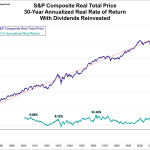 The roller coaster ride of total returns on the S&P 500! (Updated to October 2025)
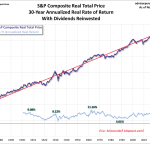 Real total SP500 in the very long term, updated 2023
